
Inter-satellite power
Power transfer between spacecraft, including power-assist concepts for small satellites and operations through eclipse periods.
Future applications
Our long-term research explores optical power links between spacecraft and to lunar assets beyond sunlight. Terrestrial experiments inform the work, while space introduces its own demands for pointing, thermal control, mass and lifetime.
Future applications
Power transfer between spacecraft, including power-assist concepts for small satellites and operations through eclipse periods.
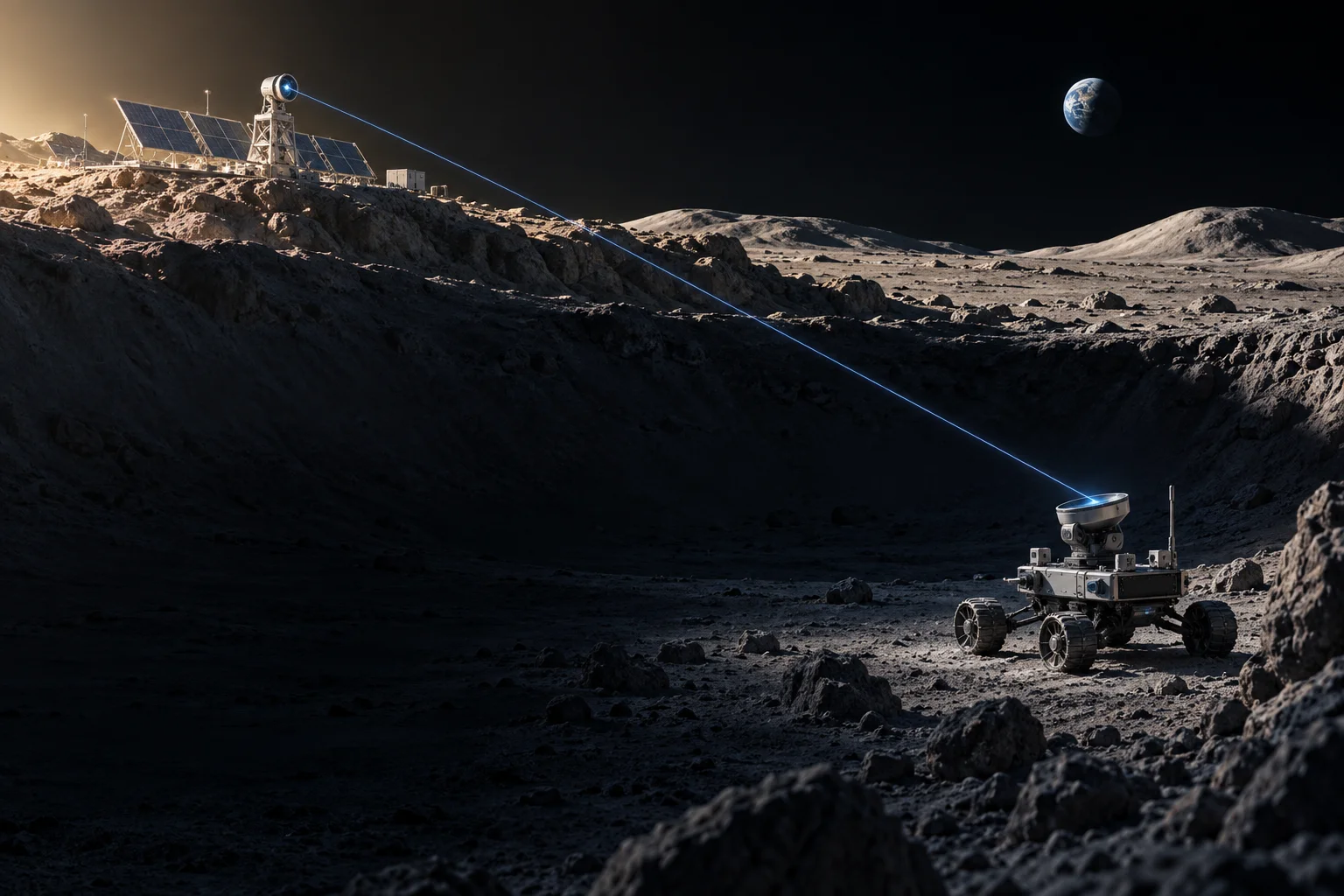
Power links for landers, rovers and infrastructure in shadowed regions, including rim-to-crater and lander-to-rover concepts and support through lunar night.
Cislunar energy services, orbital power relays and space-based solar-power concepts. These require a wider infrastructure and a separate mission-level assessment.
Engineering questions
Vacuum removes atmospheric losses on the space segment, but diffraction, acquisition and pointing, heat rejection, mass and lifetime still define the system. Orbit-to-ground links also cross the atmosphere.
Receiver area and beam propagation belong in the same mission link budget.
Relative motion and alignment set requirements for the optical terminals.
Conversion losses must be rejected as heat in the mission environment.
Apertures, radiators and power hardware must fit the platform over its mission life.
Research pathway
Terrestrial integration informs the next research questions. Each space mission needs its own assessment of the optical link and the complete spacecraft system.
We are interested in research partnerships around mission concepts, link budgets, pointing and receiver integration, and thermal and mass constraints.
Discuss a space research project